On-Die Power Rail Measurements: Setup and Best Practices
Accurate on-die power rail measurements depend on proper sense-line design, differential probing, and careful test setup at the package level.
Accurate on-die power rail measurements depend on proper sense-line design, differential probing, and careful test setup at the package level.

Transmission line losses—driven by skin effect and dielectric properties—play a critical role in degrading high-speed signal integrity and eye performance.
Transmission line loss directly affects eye diagram quality, with around −12 dB at Nyquist marking the limit before signal integrity rapidly degrades without equalization.
Three-phase power is calculated by summing individual phase values, with special considerations for line-to-line measurements, delta windings, and two-wattmeter methods.


Until now, our discussions of power calculations have encompassed only single-phase systems with one voltage and one current. Now we'll turn to three-phase systems, which can be thought of as a collection of three single-phase systems. In general, three-phase power calculations are a simple summing of the individual phase power calculations and should be balanced across all three phases.
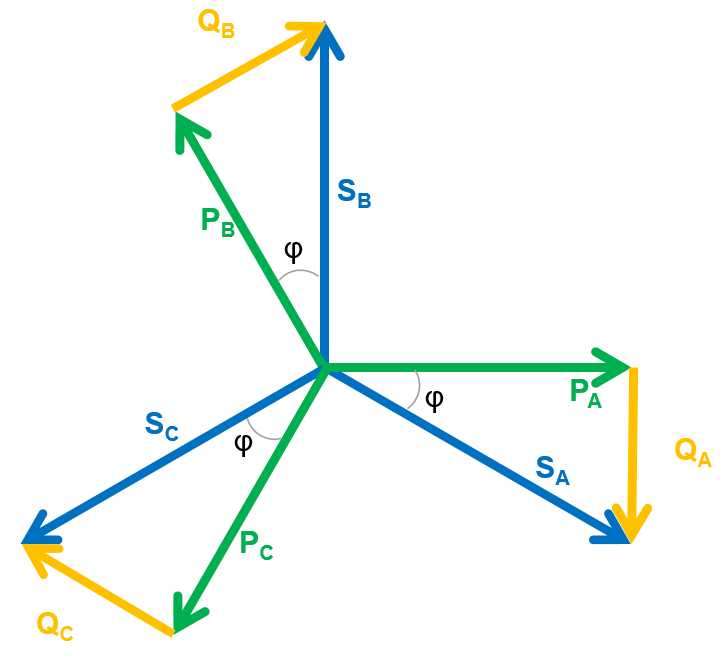
Figure 1 provides a visual representation of how this works. The formulas for real, apparent, and reactive power are:
Simple enough. However, there are some exceptions to the above. For example, if you make line-to-line voltage measurements, the voltages and currents are out of phase and must be corrected for. If your circuit has a Delta winding, you will have a terminal current and not a coil current. Measurements can still be accurate, but you may not have a balance across all three windings. An alternative approach is to use the two-wattmeter method, which will provide the correct total values but only show values for two of the three phases, and those two values will not be balanced.
Let's look more closely at the line-to-line exception. As mentioned above, in such cases, the voltage and current will be out of phase, so you need to correct for that by doing a magnitude and phase conversion to a line-to-neutral basis. Referring to Figure 2, the mathematical relationships between VA-B and VA-N are:
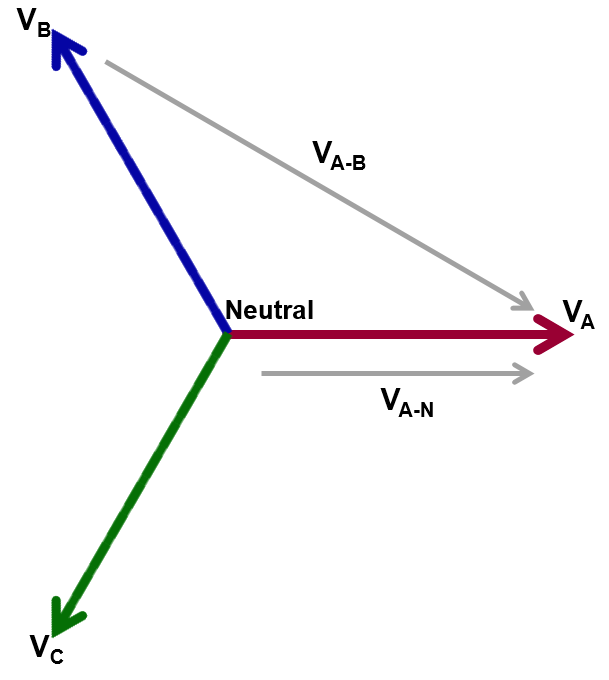
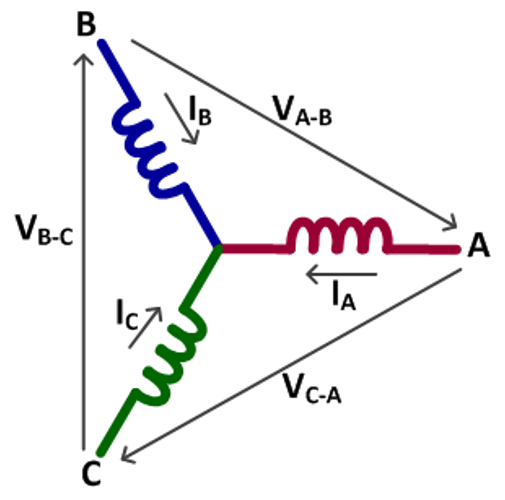
These relationships hold true for all three phases in a three-phase system. Perhaps you have a system that has voltages and currents in reference to each other (Figure 3). Voltage is often measured from line to line, but often the neutral point is inaccessible, or you may simply prefer line-to-line probing. Meanwhile, current is measured on a line-to-neutral basis. So line-to-line voltages must again be transformed to a line-to-neutral basis. We make the calculations as shown above and sum the phases to find totals in each case.
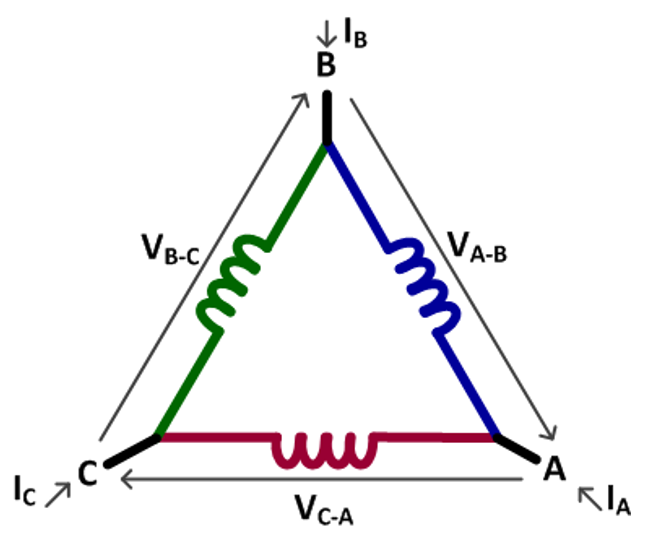
In situations involving a Delta winding, voltage is still measured line-to-line: It has to be as the neutral point is inaccessible. The current to be measured is the terminal current, which is not the same thing as the "coil" currents. The calculations as shown above will still be correct, but you may not have power balance across all three phases because you're not really measuring the "coil" current. Still, total three-phase power is still calculated as described above by summing the phases.
A two-wattmeter power measurement can be performed on a Delta or Wye winding (Figure 5). In either case, voltage is measured line-to-line on two phases, with both referenced to a common point. In the examples shown in Figure 5, the measurements are VA-C and VB-C, with C being the common reference point. Current is also measured on these two phases, so we have the A current and B current both flowing into the neutral point C.
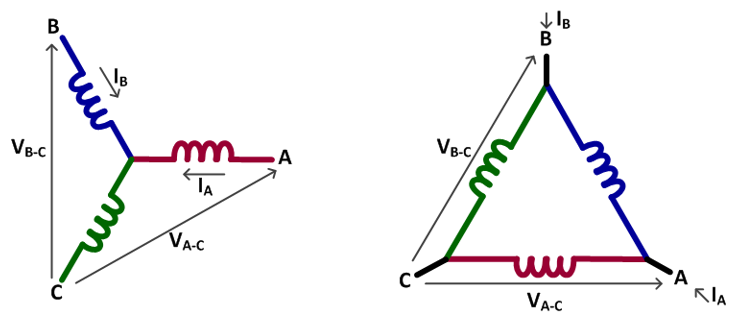
This method works because we can make mathematical assumptions. If we know two of the three voltages and currents, we can solve for the third. According to Thevenin's Theorem, we can take a line-to-line voltage and a line current, and a line current and a line-to-line voltage, and calculate the three-phase power directly from that information. The mathematical assumptions are as follows:
Copyright © 2020-2026 Teledyne LeCroy. All rights reserved. All original content, including text and photos, is the property of Teledyne LeCroy and cannot be reproduced without expressed written permission.

Electrical power spans generation, distribution, and consumption—where motors and modern power electronics dominate global energy use and measurement challenges.

AC line power is a rotating voltage vector measured in RMS terms, with peak, peak-to-peak, and rectified values that differ significantly from the familiar “120 VAC” rating.

Three-phase AC voltages consist of three balanced sinusoidal vectors separated by 120°, with measurable differences between line-to-line and line-to-neutral values.

AC line current is a rotating sinusoidal vector—single- or three-phase—whose accurate measurement depends on system configuration and the right choice of current sensor.