On-Die Power Rail Measurements: Setup and Best Practices
Accurate on-die power rail measurements depend on proper sense-line design, differential probing, and careful test setup at the package level.
Accurate on-die power rail measurements depend on proper sense-line design, differential probing, and careful test setup at the package level.

Transmission line losses—driven by skin effect and dielectric properties—play a critical role in degrading high-speed signal integrity and eye performance.
Transmission line loss directly affects eye diagram quality, with around −12 dB at Nyquist marking the limit before signal integrity rapidly degrades without equalization.
Following key measurement best practices—anticipating results, understanding instrument limits, defining objectives, and validating consistency—helps ensure accurate oscilloscope measurements.

We’re going to talk about four measurement "best practices", which will help you get the most out of any oscilloscope you have. These are important when doing any type of measurement—and you can get a good start on them simply by asking yourself the four questions in the sidebar.
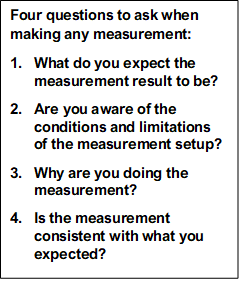
Those who are familiar with Dr. Eric Bogatin’s Rule #9 will know this one. Before you do any measurement, anticipate what you expect the result to be, because that is the most important way of identifying if there is a potential problem.
Situational awareness is being aware of what your measurement system is doing, as well as what in the laboratory environment can affect the measurement. The measurement system is the oscilloscope plus the probes and the interface to your device under test. You want to be aware of the conditions and limitations of that entire measurement setup. For instance, how is it connected? What kinds of artifacts and anomalies might result from your connection method, and which might you want to pay attention to as indicators of a problem? What artifacts and anomalies can you rule out because they are a result of noise in the environment or noise due to the test setup versus a problem with the DUT?
As much as we would like it to be otherwise, there is no such thing as a perfect measurement instrument. Everything has a limitation. You want to be aware of the features of your device under test (DUT) and how those features compare to the limitations of your measurement system. When the performance of the DUT gets close to that boundary, that is when you especially want to pay attention to potential artifacts. On any oscilloscope, you always want to be aware of three key specifications and how they will be affected by the bitrate/frequency and amplitude of the signal you are measuring:
You also want to be aware of how changing control settings like the trigger level, timebase or vertical scale will change the performance of the instrument.
The third essential measurement best practice is knowing why you are doing the measurement. What question are you trying to answer? What are you going to do with that measurement?
The raw data resulting from the measurements may consist of millions of data points. What you have to do is take all that measured data and condense it into a few important numbers that characterize that measurement — known as “figures of merit”—because that is ultimately what you are going to use to answer some design question or decide on some action.
The goal here is to make sure your results are consistent with other measurements. Perform every measurement you can think of in order to test your understanding of the measurement. The more tests where the results are consistent with what you expected to see, the more confidence you will have in your understanding.
Copyright © 2020-2026 Teledyne LeCroy. All rights reserved. All original content, including text and photos, is the property of Teledyne LeCroy and cannot be reproduced without expressed written permission.

Automatic FFT tools turn oscilloscopes into intuitive spectrum analyzers, simplifying setup while revealing key frequency components in real time.

A hands-on approach to FFTs reveals how manual oscilloscope settings expose hidden frequency-domain details in seemingly simple signals.

A practical FFT workflow reveals hidden frequency-domain insights in power supply noise that time-domain analysis alone cannot show.

Oscilloscope tools like measurement parameter tracking and histograms reveal how PWM pulse width, duty cycle, and modulation behavior change over time.
