On-Die Power Rail Measurements: Setup and Best Practices
Accurate on-die power rail measurements depend on proper sense-line design, differential probing, and careful test setup at the package level.
Accurate on-die power rail measurements depend on proper sense-line design, differential probing, and careful test setup at the package level.

Transmission line losses—driven by skin effect and dielectric properties—play a critical role in degrading high-speed signal integrity and eye performance.
Transmission line loss directly affects eye diagram quality, with around −12 dB at Nyquist marking the limit before signal integrity rapidly degrades without equalization.
Transmit de-emphasis enhances eye diagrams by reducing inter-symbol interference, improving signal clarity at the cost of lower overall amplitude.

Having discussed what transmit pre-emphasis is all about and the various ways in which it's implemented, it might be useful at this juncture to look at some examples of its application and the salutary effect it can have on the signal's eye diagram at the receiver end of the channel. Recall that there are two variations on pre-emphasis: de-emphasis and pre-shoot, which use different taps of a three-tap finite impulse response (FIR) filter to emphasize the last bit or the first bit of a bit sequence, respectively.
The examples we'll look at are of the de-emphasis variety, and we'll examine three levels of application of de-emphasis: none, -3 dB, and -6 dB. Each image shows us the signal at the transmitter before it undergoes de-emphasis (at center top) and the signal as seen at the receiver side of the channel (at center bottom).
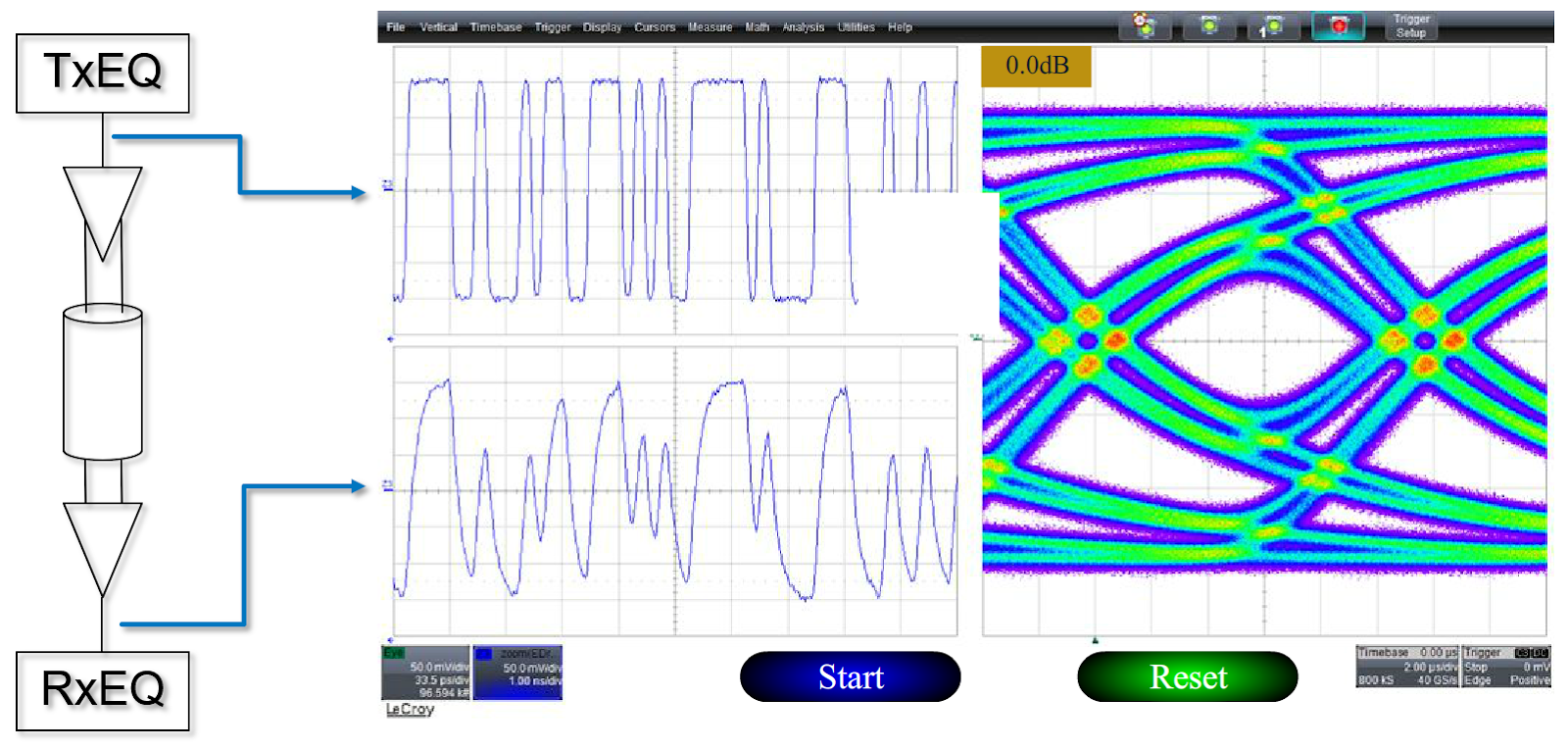
For starters, Figure 1 shows us the eye diagram for the raw, unprocessed signal. The eye center is open, but it's apparent that the transitions are not at all sharp, which the waveform at center bottom confirms. The signal has fallen victim to the losses incurred in the channel.
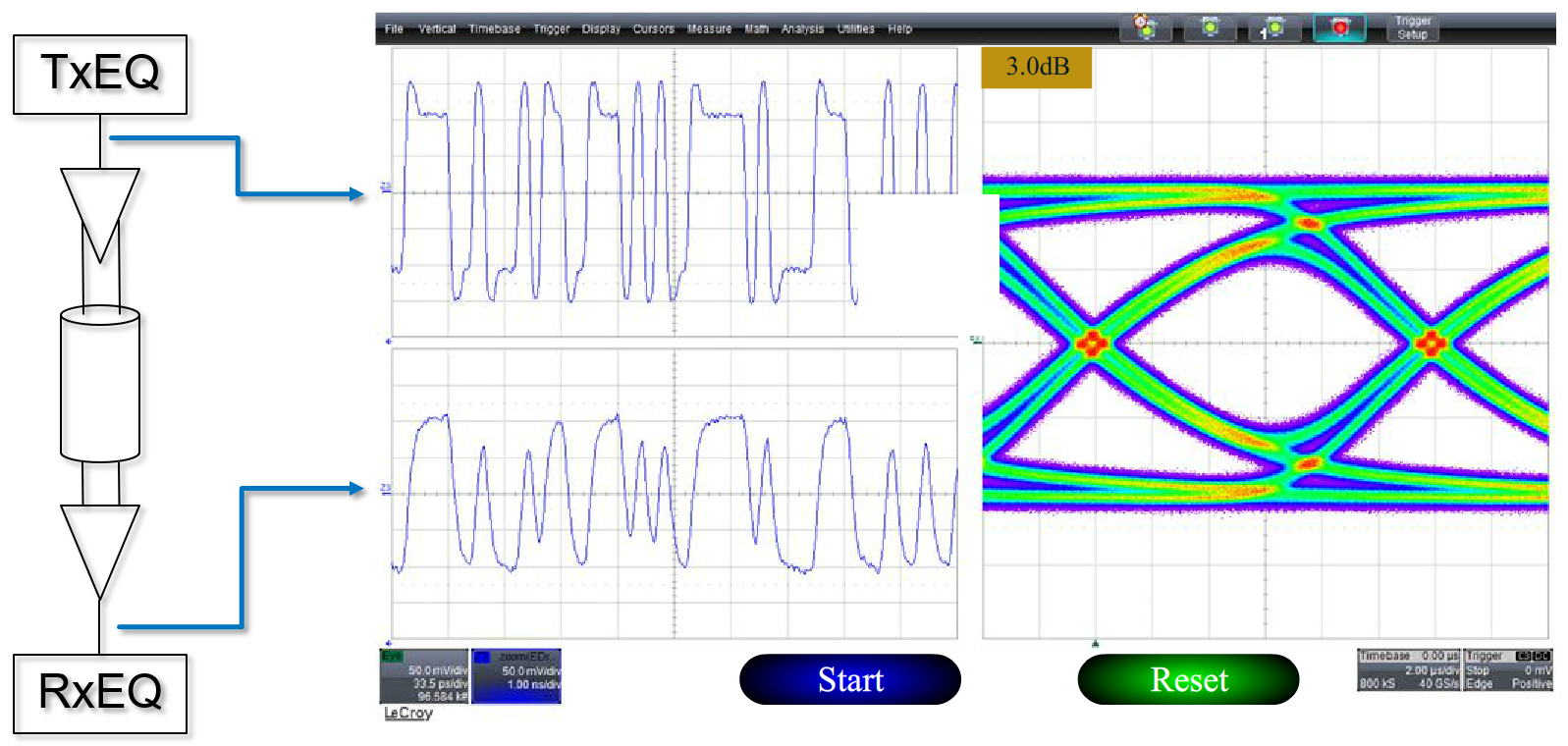
As we begin to apply transmit de-emphasis, the eye margins in terms of height and width will improve. On the other hand, the overall eye amplitude decreases. In Figure 2, reducing the amplitude of all the bits following the first bit by -3 dB already demonstrates a marked improvement in the eye margins. But note the reduction in overall eye amplitude.
Why does de-emphasis produce these results? Rather than emphasizing the first bit and maintaining the subsequent bits at the original amplitude, transmit de-emphasis maintains the original amplitude of the first bit and reduces the amplitude of the bits that follow. This has a much greater effect in improving eye margins at the receiver than simply boosting that first bit.
Emphasizing the first bit by increasing its amplitude can cause non-linear saturation effects in the transmitter's drivers. It's preferable to keep that first bit at its nominal voltage level and reduce the amplitude of the subsequent bits. This, by the way, is the main difference between the terms "pre-emphasis" and "de-emphasis." The former typically refers to pre-distorting the signal before it's pushed into the channel, and the latter specifically refers to the process outlined here.
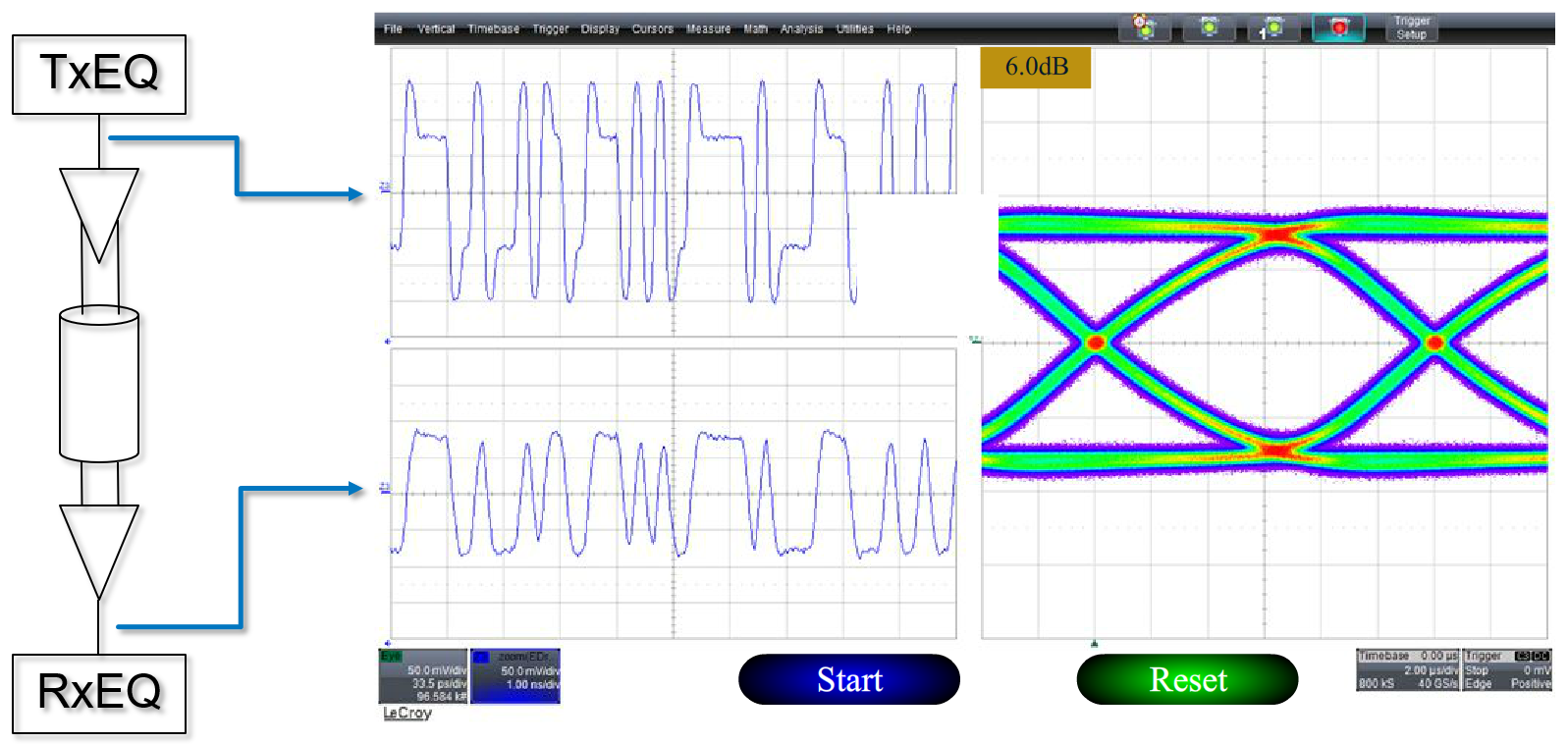
If we further increase the difference in amplitude between the first bit and the subsequent bits to -6 dB, we find that the eye margins have become even better and the eye amplitude has decreased further (Figure 3). Transitions are clean and crisp.
It's worth noting that de-emphasis is only applied to strings of ones and zeroes in the bit stream, and not to single bits. The behavior of single bits in the bit stream would not be affected by de-emphasis.
Copyright © 2020-2026 Teledyne LeCroy. All rights reserved. All original content, including text and photos, is the property of Teledyne LeCroy and cannot be reproduced without expressed written permission.

Channel equalization uses transmitter and receiver techniques to counteract losses, reduce ISI, and improve signal quality in high-speed data links.

Continuous Time Linear Equalization (CTLE) enhances high-speed serial signals by compensating for channel loss, improving eye openings while balancing noise performance.

S-parameters allow engineers to model, remove, or simulate channel effects in high-speed serial links, helping diagnose signal degradation and improve performance.

TDME oscilloscope software enables engineers to measure serial bus performance and convert encoded data into analog waveforms for deeper debugging and analysis.
