On-Die Power Rail Measurements: Setup and Best Practices
Accurate on-die power rail measurements depend on proper sense-line design, differential probing, and careful test setup at the package level.
Accurate on-die power rail measurements depend on proper sense-line design, differential probing, and careful test setup at the package level.

Transmission line losses—driven by skin effect and dielectric properties—play a critical role in degrading high-speed signal integrity and eye performance.
Transmission line loss directly affects eye diagram quality, with around −12 dB at Nyquist marking the limit before signal integrity rapidly degrades without equalization.
Channel equalization uses transmitter and receiver techniques to counteract losses, reduce ISI, and improve signal quality in high-speed data links.

A number of factors can cause degradation of performance in a high-speed serial data link. Among them are inter-symbol interference (ISI) jitter, attenuation, reflections due to impedance mismatches, and insertion losses, to name a few. But fear not: There are techniques one may use to compensate for these losses known as equalization. We'll review the basics of channel equalization in today's post.
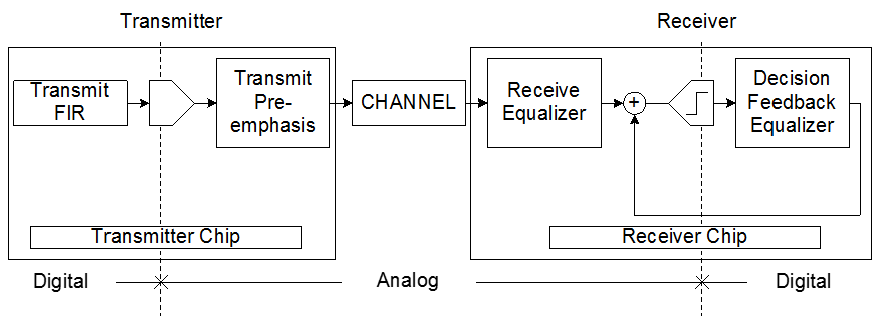
One type of equalization is transmit pre-emphasis, in which the transmitted signal is "pre-distorted" by boosting high-frequency transitions relative to low-frequency transitions to compensate for the deleterious effects of the channel (Figure 1). Pre-emphasis comes in two flavors: pre-shoot and de-emphasis. Transmit pre-emphasis is technically not equalization, but it has the same goal of reducing the link's bit-error rate (BER), so it can be thought of as a form of equalization.
After the signal traverses the channel, there are three types of equalization at the receiver: feedforward equalization (FFE), continuous time linear equalization (CTLE), and decision feedback equalization (DFE). Linear filtering at the receiver, accomplished either as a low-pass filter in CTLE or by using an FIR filter, boosts the signal's high-frequency content. DFE is a non-linear filter that also boosts high frequencies but does so after the detector or "slicer."
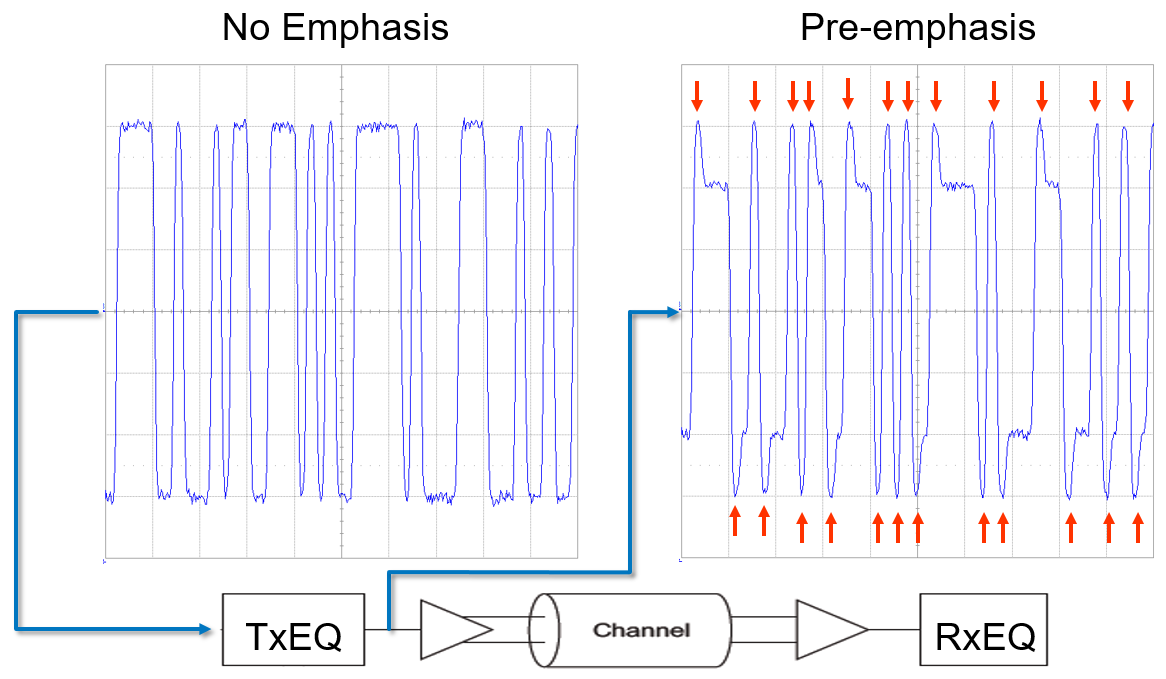
What does pre-emphasis look like in terms of its effect on the signal as it leaves the transmitter? At left in Figure 2 is a serial-data signal before applying emphasis; at right is the same signal after pre-emphasis, although, in this case, it's actually de-emphasis that's applied. Note that after the first bit in each one and zero, the subsequent bits are de-emphasized with respect to the first bit in terms of amplitude.
Pre-emphasis on the transmitted signal is implemented using a multi-tap finite impulse response (FIR) filter, which applies delay and inversion to the signal and then adds it back to the original signal with the proper weight. This is intended to counter the effects of inter-symbol interference due to dispersion by adding the dispersed portion of the signal's energy back to the original signal.
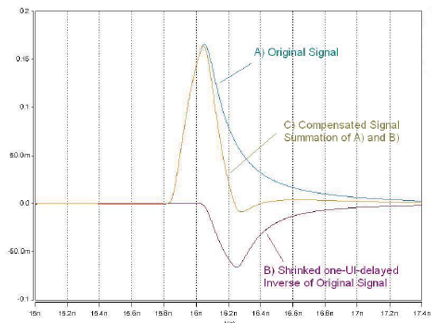
The image in Figure 3 will help illustrate what's going on. The original signal (A at top) is significantly broadened by channel effects. Signal B at bottom is the shrunken, one-UI-delayed inversion of the original signal that's multiplied by a tap coefficient of the FIR filter, and then added back to the original signal. The resulting compensated signal C exhibits diminished pulse broadening and less prominent ISI effects.
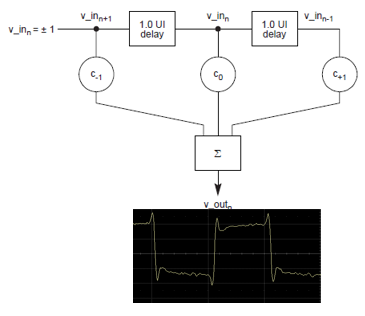
Typically, the FIR filters used to perform transmitter pre-emphasis are three-tap filters. One tap handles pre-cursor ISI, one post-cursor ISI, and one current-cursor ISI, as shown in Figure 4. The effect of the pre-cursor tap (tap C-1 in Figure 4) would be to emphasize the last bit in a given bit sequence as shown in Figure 5.
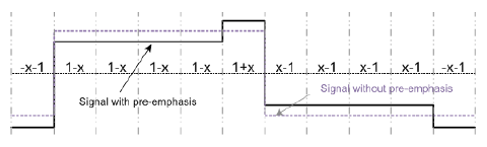
This represents the "pre-shoot" flavor of transmitter pre-emphasis. The post-cursor tap (tap C+1 in Figure 4) emphasizes the first bit of a given bit sequence (Figure 6) and de-emphasizes the rest; hence, it's referred to as "de-emphasis."
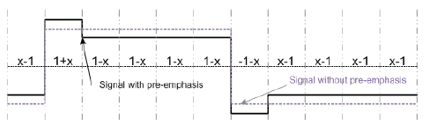
The net effect of a three-tap FIR filter is to generate a signal with the proper amounts of de-emphasis and pre-shoot to pre-distort the signal in anticipation of the channel losses it would see. We expect the higher frequencies to be attenuated to a much higher degree by the channel, so we boost those high-frequency components of the signal, which are concentrated on the signal's edges, to pre-emptively cancel out the channel's effects.
Copyright © 2020-2026 Teledyne LeCroy. All rights reserved. All original content, including text and photos, is the property of Teledyne LeCroy and cannot be reproduced without expressed written permission.

Transmit de-emphasis enhances eye diagrams by reducing inter-symbol interference, improving signal clarity at the cost of lower overall amplitude.

Continuous Time Linear Equalization (CTLE) enhances high-speed serial signals by compensating for channel loss, improving eye openings while balancing noise performance.

S-parameters allow engineers to model, remove, or simulate channel effects in high-speed serial links, helping diagnose signal degradation and improve performance.

TDME oscilloscope software enables engineers to measure serial bus performance and convert encoded data into analog waveforms for deeper debugging and analysis.
