On-Die Power Rail Measurements: Setup and Best Practices
Accurate on-die power rail measurements depend on proper sense-line design, differential probing, and careful test setup at the package level.
Accurate on-die power rail measurements depend on proper sense-line design, differential probing, and careful test setup at the package level.

Transmission line losses—driven by skin effect and dielectric properties—play a critical role in degrading high-speed signal integrity and eye performance.
Transmission line loss directly affects eye diagram quality, with around −12 dB at Nyquist marking the limit before signal integrity rapidly degrades without equalization.
Fast-rising signals can introduce transmission line reflections that appear as ringing on an oscilloscope, but proper 50-ohm termination can eliminate these artifacts.

It is easy to take a measurement with an oscilloscope and see a voltage waveform on the screen. It is sometimes hard to take a measurement without artifacts and interpret all the details of the measurement.
Whenever you measure a signal with a rise time shorter than about 20 ns, assuming a 1 m long coax cable, transmission line effects should pop to the top of your list of potential artifacts to consider and avoid.
Unfortunately, when we learned about transmission lines in college, we generally learned about them in RF applications, which means in the frequency domain. While these principles are perfectly correct, they don’t help when it comes to understanding the properties of transmission lines with regards to digital signals.
When the source impedance of the Device Under Test (DUT) is much lower than 50 ohms, and the oscilloscope is set to 50 ohm input, you will see what looks like ringing at the oscilloscope. An example is shown in Figure 1.
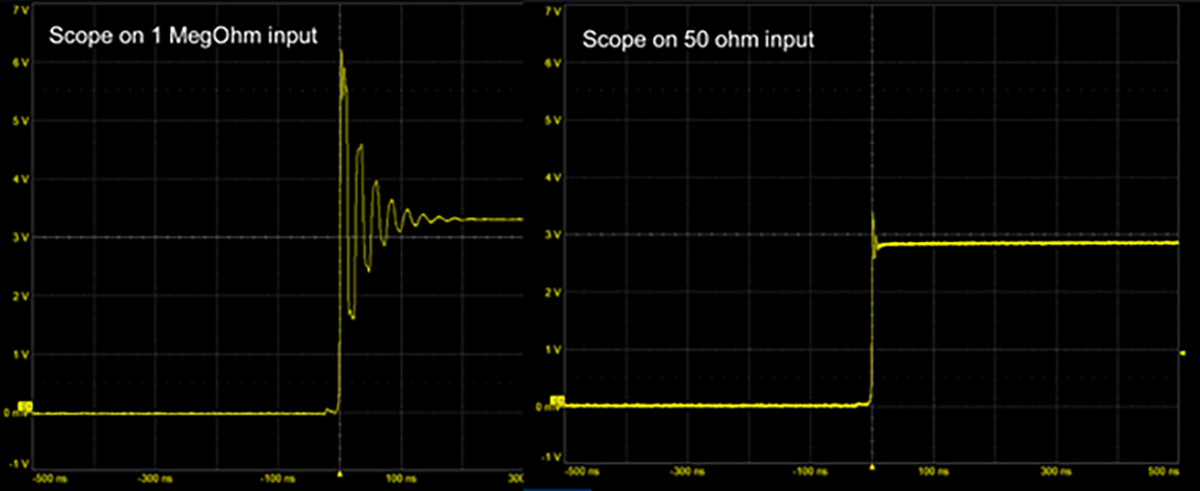
The root cause of this ringing is reflection between the 50 ohm coax cable and the 1 mega-ohm input to the oscilloscope, then reflection again from the 50 ohm coax cable to the low impedance of the DUT. Every time the signal hits the interface between the 50 ohm cable and low impedance of the DUT, the sign of the reflected voltage changes. This causes the high-low-high-low signature at the oscilloscope.
The way to eliminate this problem is to use 50 ohm input to the oscilloscope. This prevents any reflections and kills the ringing, as shown in Figure 1. The reason every oscilloscope has a 50 ohm impedance input is because we assume the connection to the DUT uses a 50 ohm coax cable. There is no reflection from the 50 ohm cable to the 50 ohm resistor at the front of the oscilloscope.
One important warning, though: before you use 50 ohm termination into the oscilloscope, make sure the source voltage is lower than 5 Vrms. The maximum power dissipation of the 50 ohm resistor in the oscilloscope is 0.5 watts. If you exceed this power consumption, the resistor will heat up and possibly be damaged. Always make sure the average power into the oscilloscope is less than 0.5 watts before using the 50 ohm termination.
Generally, if the rise time of your signal is shorter than 20 ns and you are not using a 10x probe, you want to consider using the oscilloscope's 50 ohm input to avoid this important artifact.
Copyright © 2020-2026 Teledyne LeCroy. All rights reserved. All original content, including text and photos, is the property of Teledyne LeCroy and cannot be reproduced without expressed written permission.
Copyright © 2020-2026 Teledyne LeCroy. All rights reserved. All original content, including text and photos, is the property of Teledyne LeCroy and cannot be reproduced without expressed written permission.

Accurate on-die power rail measurements depend on proper sense-line design, differential probing, and careful test setup at the package level.

Transmission line losses—driven by skin effect and dielectric properties—play a critical role in degrading high-speed signal integrity and eye performance.

Transmission line loss directly affects eye diagram quality, with around −12 dB at Nyquist marking the limit before signal integrity rapidly degrades without equalization.

This article explains how PDN design, probing method, and measurement location influence power rail noise—and why board-level measurements can be misleading.