On-Die Power Rail Measurements: Setup and Best Practices
Accurate on-die power rail measurements depend on proper sense-line design, differential probing, and careful test setup at the package level.
Accurate on-die power rail measurements depend on proper sense-line design, differential probing, and careful test setup at the package level.

Transmission line losses—driven by skin effect and dielectric properties—play a critical role in degrading high-speed signal integrity and eye performance.
Transmission line loss directly affects eye diagram quality, with around −12 dB at Nyquist marking the limit before signal integrity rapidly degrades without equalization.
A simple 50-ohm source series termination enables accurate, low-cost power rail measurements without the reflections caused by direct coax connections.

In an earlier post, we discussed the limitations of Using 50-Ohm Coax from DUT to Oscilloscope with low-voltage, high-bandwidth signals, like power rails. In this post, we’ll explain how to build your own, low-cost power rail probe to serve the purpose.
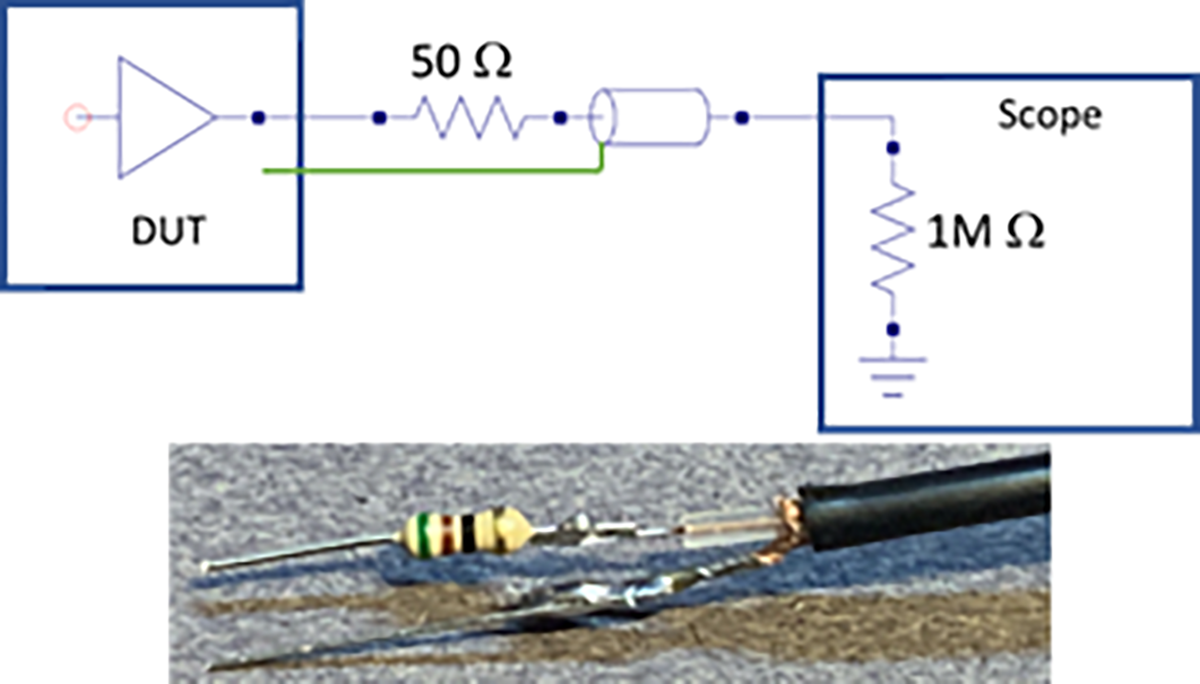
The source series termination method is a good alternative for probing a low-impedance, fast-switching source, comprising a 50-ohm resistor in series between the DUT and the coaxial-cable connection. The coaxial cable is then connected to the oscilloscope’s analog input set for 1 megaohm termination. An equivalent circuit model and a simple implementation appears in Figure 1.
When measuring most high-bandwidth signals, 50 ohm is the recommended input impedance to the oscilloscope. This does not hold true, however, for power rails. For one, with 50-ohm input impedance, the maximum voltage one can probe is typically around 5 V. Higher voltages will dissipate too much power in the 50-ohm resistor, and the oscilloscope may suffer damage. For another, using 50-ohm input impedance will introduce a DC load to the DUT.
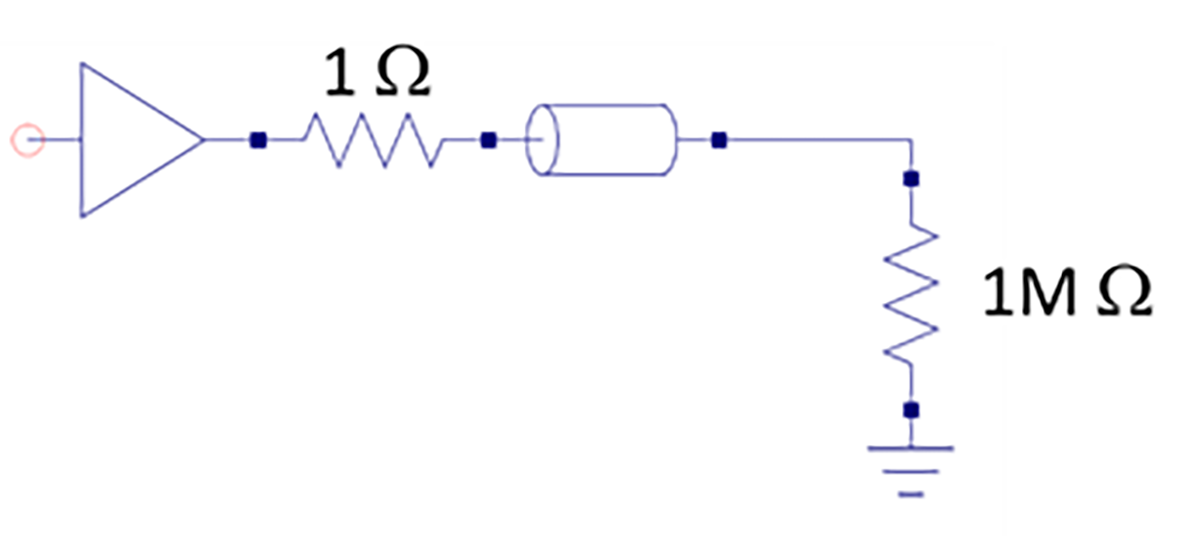
Thus, we must use the oscilloscope’s 1 megaohm input. On one hand, this enables measurement of a voltage range of ±40 V with a negligible DC current draw. On the other, when probing a low-impedance source via a direct coax connection, the oscilloscope’s 1 megaohm input termination will generate large reflections from fast transient edges. The equivalent circuit is shown in Figure 2.
The answer to this problem: add a 50-ohm source series termination at the end of the coaxial cable. As a result, half of the source voltage is initially launched into the coax cable, which reaches the oscilloscope’s 1 megaohm input termination and reflects back. The initial voltage measured by the oscilloscope is 2x the launched voltage, which is exactly the voltage of the source.
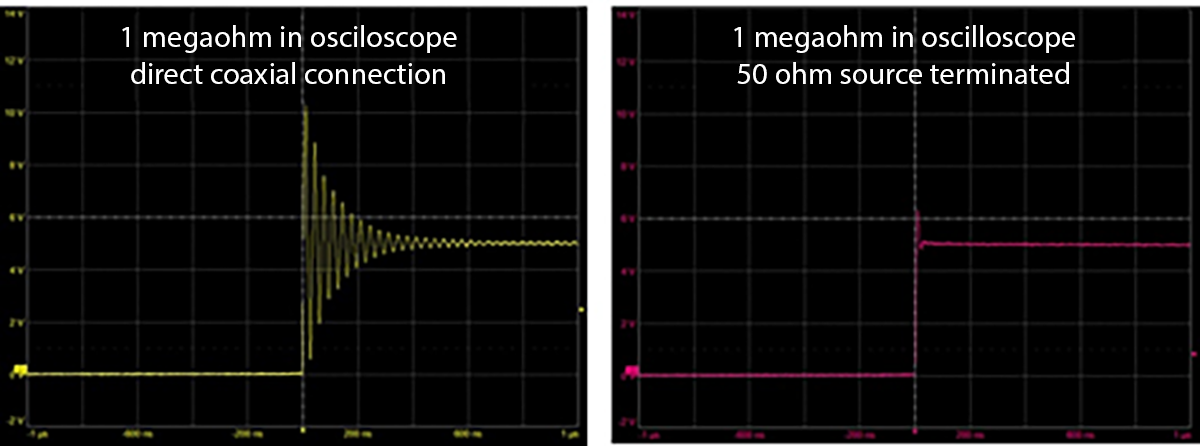
When the reflected signal makes its way to the source, it sees the 50-ohm resistor in series with the low impedance of the source. As long as the source impedance is less than 5 ohm, there is virtually no reflection and the reflections are terminated. Figure 3 shows an example of a 5 V switched mode power supply input with a direct coaxial cable connection and with a 50-ohm source series termination. This simple approach of adding a 50-ohm source series resistance is a low-cost alternative to probing power rails at high bandwidth. It is an alternative to using a 10x probe, with the advantage of being a 1x probe that does not attenuate the signal.
Of course, a far better solution, if your budget permits, is the RP4030 Active Voltage Rail Probe, which is designed specifically to probe a 50-ohm DC voltage/power rail while coupled to the 50 ohm oscilloscope input for the lowest noise and minimal DUT loading.
Copyright © 2020-2026 Teledyne LeCroy. All rights reserved. All original content, including text and photos, is the property of Teledyne LeCroy and cannot be reproduced without expressed written permission.

Accurate on-die power rail measurements depend on proper sense-line design, differential probing, and careful test setup at the package level.

Transmission line losses—driven by skin effect and dielectric properties—play a critical role in degrading high-speed signal integrity and eye performance.

Transmission line loss directly affects eye diagram quality, with around −12 dB at Nyquist marking the limit before signal integrity rapidly degrades without equalization.

This article explains how PDN design, probing method, and measurement location influence power rail noise—and why board-level measurements can be misleading.